
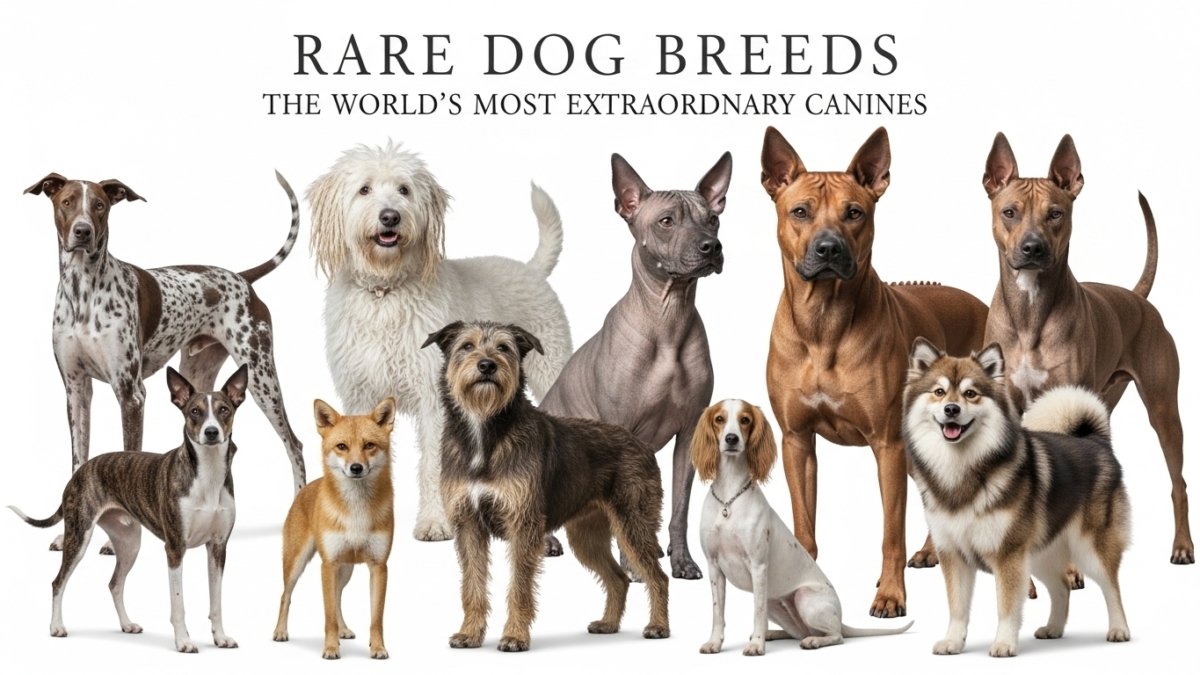
Beyond the golden retrievers and German shepherds that populate every park, a remarkable world of rare dog breeds exists ancient working dogs, island survivors, aristocratic companions each shaped by centuries of isolation, purpose, and human partnership. This guide takes you deep into that fascinating, often-overlooked corner of the canine kingdom.
What Makes a Dog Breed Truly Rare?
Rarity in the dog world is defined by more than simple population numbers. A breed may be considered rare because it exists in only a single country, because its global population falls below a few thousand individuals, or because it has never been formally recognized by major kennel clubs like the American Kennel Club (AKC) or the Fédération Cynologique Internationale (FCI).
Some breeds are rare by circumstance wars, habitat loss, or shifting agricultural practices wiped out most of their numbers. Others are rare by design: isolated island communities or remote mountain villages developed dogs so specialized for local conditions that they simply never spread beyond their homeland. Whatever the reason, rare breeds carry irreplaceable genetic diversity and cultural history that deserves our attention and protection.
Every rare breed is a living archive a story of the people who bred them, the landscapes that shaped them, and the work that gave them purpose for hundreds of years.
10 Most Fascinating Rare Dog Breeds in the World
Below, we profile ten of the rarest, most captivating dog breeds from across the globe from the misty fjords of Norway to the sun-scorched plains of Africa.
01
Norwegian Lundehund
🇳🇴 Norway
Perhaps the most anatomically unique dog alive. The Lundehund has six fully functional toes on each foot, an exceptionally flexible neck that can bend backward to touch its spine, and ears that fold shut. Originally bred to hunt puffins from cliff crevices on remote Norwegian islands, this breed nearly vanished after World War II fewer than five individuals survived at one point.
02
Azawakh
🌍 West Africa (Mali, Niger, Burkina Faso)
A striking sighthound of the Tuareg and other nomadic Saharan peoples, the Azawakh is built for extreme speed in scorching desert heat. Lean to the point of appearing skeletal with ribs, hip bones, and spine visible this dog is no less than a masterpiece of evolutionary adaptation. They are fiercely loyal to their family yet deeply aloof with strangers.
03
Otterhound
🇬🇧 England
With fewer than 1,000 individuals worldwide, the Otterhound is considered one of the most endangered dog breeds in existence rarer than many wild animal species. Originally bred in medieval England to hunt otters from rivers, this shaggy, boisterous hound has an extraordinary nose and a deep, melodious voice. Despite its charm, it remains critically underappreciated.
04
Mudi
🇭🇺 Hungary
A versatile Hungarian herding breed that is almost unknown outside Central Europe. The Mudi is highly intelligent, agile, and energetic capable of herding large flocks of sheep and cattle single-handedly. Its curly, wavy coat and wedge-shaped head give it an almost foxlike appearance. Today, enthusiasts worldwide are working to raise awareness of this extraordinary, rare working dog.
05
Xoloitzcuintli (Xolo)
🇲🇽 Mexico
One of the oldest and rarest breeds on Earth, the Xolo (pronounced “show-low”) has existed for over 3,000 years. Ancient Aztecs considered this hairless dog sacred — believed to guide souls safely through the underworld. Available in both hairless and coated varieties, and in three sizes, the Xolo is a calm, attentive companion with a body warm to the touch, like a living hot water bottle.
06
Catalburun
🇹🇷 Turkey
The Catalburun (meaning “fork nose” in Turkish) is one of only three dog breeds in the world with a split nose a distinctive double nostril that is said to dramatically enhance its scenting ability. An exceptional hunting dog used primarily to track game in the rugged terrain of southern Turkey, this breed is almost entirely absent outside its homeland and remains virtually unknown internationally.
07
Bergamasco Sheepdog
🇮🇹 Italy
Instantly recognizable by its astonishing coat a dense mass of naturally forming felt-like mats called “flocks” that cover the entire body. This ancient Alpine herding breed developed its remarkable coat to protect it from the freezing temperatures and the bites of wolves high in the Italian mountains. Despite its extraordinary appearance, the Bergamasco is a gentle, patient, and deeply intelligent companion.
08
New Guinea Singing Dog
🇵🇬 Papua New Guinea
Among the most ancient and primitive dog breeds or perhaps proto-dogs still in existence, the New Guinea Singing Dog is named for its haunting, harmonic howl, which resembles a wolf’s song modulated into something almost musical. Wild populations live in the remote highlands of Papua New Guinea. Captive populations worldwide are tiny, and serious conservation efforts are underway to preserve this living relic.
09
Lagotto Romagnolo
🇮🇹 Italy (Romagna region)
Ancient Italian water retriever turned world-class truffle hunter. The Lagotto is today the only officially recognized truffle-hunting breed in the world, prized for its extraordinary nose and tireless work ethic in the dense Italian undergrowth. With its tight, woolly curls and warm, expressive eyes, it is also a highly affectionate family dog though it remains far less common than its talents deserve.
10
Chinook
🇺🇸 United States (New Hampshire)
America’s own rare breed, the Chinook was developed in New Hampshire in the early 20th century specifically as a sled dog. Named after the lead dog of explorer Arthur Walden’s famous 1927 Antarctic expedition, the breed nearly went extinct in 1981 when only 11 breeding individuals remained. Through dedicated recovery efforts, it has come back from the brink but remains one of the rarest dog breeds in America.
Why Are Some Dog Breeds So Rare?
Understanding rarity requires looking at the forces historical, economic, and cultural that push breeds to the margins. Several key factors drive a breed’s decline:
1. Loss of Traditional Purpose
Many rare breeds were purpose-built for jobs that no longer exist at scale hunting otters, herding reindeer across Arctic tundra, retrieving fishing nets from icy Norwegian fjords. When mechanization and changing land use made these roles obsolete, the need to breed and maintain these dogs largely disappeared. Without working roles to justify their numbers, populations shrank rapidly.
2. Geographic Isolation
Breeds that developed in isolated regions remote islands, mountain villages, desert communities often never gained international recognition or a global breeding population. When external pressures (disease, war, economic collapse) hit these isolated communities, there was no global safety net of breeders to maintain the gene pool.
3. Competition from Popular Breeds
The global dominance of a handful of highly popular breeds Labradors, German Shepherds, French Bulldogs means that rare breeds struggle to find buyers, breeders, and advocates. The top 10 most popular breeds account for a disproportionate share of all registered dogs worldwide, leaving hundreds of other breeds competing for a tiny slice of the market.
4. Wars and Political Upheaval
Both World Wars devastated dog populations across Europe. Food shortages meant dogs were often abandoned or culled, and several breeds the Norwegian Lundehund, the Otterhound, and others were reduced to alarmingly small populations from which they never fully recovered.
Key Facts About Rare Dog Breeds
📋 Quick Reference Facts
- The FCI recognizes over 360 official dog breeds worldwide, but hundreds more exist without formal recognition.
- The Otterhound has a global population estimated at fewer than 1,000 individuals, making it more endangered than many wild species.
- The Norwegian Lundehund has six toes per paw more than any other dog breed a unique adaptation for climbing rocky cliffs.
- The New Guinea Singing Dog was thought to be extinct in the wild until a 2020 study confirmed surviving wild populations in the Papua New Guinea highlands.
- The Xoloitzcuintli is depicted in ancient Aztec artifacts dating back more than 3,000 years, making it one of the oldest known domesticated breeds.
- The American Rare Breed Association (ARBA) and similar organizations worldwide work to register and preserve rare breeds outside mainstream kennel clubs.
Rare Dog Breeds at a Glance: Quick Comparison
The table below provides a fast-reference overview of the ten rare breeds profiled in this article:
| Breed | Origin | Size | Temperament | Est. Global Population |
| Norwegian Lundehund | Norway | Small | Alert, Energetic | < 2,000 |
| Azawakh | West Africa | Medium–Large | Loyal, Aloof | < 5,000 |
| Otterhound | England | Large | Boisterous, Friendly | < 1,000 |
| Mudi | Hungary | Medium | Intelligent, Agile | ~5,000 |
| Xoloitzcuintli | Mexico | Small–Large | Calm, Attentive | < 3,000 |
| Catalburun | Turkey | Medium | Hardy, Focused | < 200 |
| Bergamasco Sheepdog | Italy | Medium–Large | Patient, Gentle | ~2,000 |
| New Guinea Singing Dog | Papua New Guinea | Small–Medium | Wild, Independent | < 300 (captive) |
| Lagotto Romagnolo | Italy | Medium | Affectionate, Keen | ~10,000 |
| Chinook | USA | Large | Calm, Devoted | ~1,000 |
Are Rare Dog Breeds Good Pets?
This is one of the most common questions prospective dog owners ask when they discover rare breeds. The answer is nuanced, and it depends heavily on the specific breed and your lifestyle. Here’s what you need to know:
Rare breeds are often highly specialized. Many were developed for intense, specific working roles and they retain those instincts and energy levels today. An Azawakh needs room to sprint. A Mudi needs a job to do. A Norwegian Lundehund has a digestive condition so specific to its breed that specialized diet management is essential. These are not beginner dogs for someone seeking a low-maintenance companion.
That said, for the right owner experienced, committed, and genuinely interested in the breed’s history a rare breed can be one of the most deeply rewarding dog ownership experiences imaginable. You become part of a tiny global community of guardians, often personally knowing breeders and enthusiasts across the world.
Owning a rare breed is not just pet ownership. It is stewardship. You are helping to carry an ancient lineage forward into a future that needs its diversity.
How to Find and Responsibly Adopt a Rare Breed
If you’re serious about bringing a rare dog breed into your life, the process requires more diligence than simply walking into a pet shop. Here is a responsible roadmap:
- 1
- Connect with breed-specific clubs and registries. For nearly every recognized rare breed, a national or international breed club exists. These organizations maintain breeder directories, health registers, and educational resources. They are your single best starting point.
- 2
- Expect waiting lists. For genuinely rare breeds, responsible breeders may have litters only every few years. Waiting 12–24 months for a puppy is entirely normal and a good sign that the breeder is not overbreeding.
- 3
- Demand health testing documentation. Rare breeds often carry breed-specific health challenges due to small gene pools. Reputable breeders will test for known genetic conditions and provide full health records for both parents.
- 4
- Never buy from puppy mills or pet shops. Unscrupulous commercial breeders will exploit growing interest in rare breeds. Purchasing from them actively harms breed health and conservation efforts.
- 5
- Consider adoption and rescue. Even rare breeds sometimes end up in rescue. Organizations like the Rare Breed Rescue network and breed-specific rescues can be excellent sources, and you’ll give a deserving dog a second chance.
- 6
- Commit to the community. When you own a rare breed, you implicitly take on a role in its preservation. Joining breed clubs, attending shows, sharing your dog’s story, and supporting conservation research all matter.
The Future of Rare Dog Breeds: Conservation and Hope
The good news is that awareness of rare breeds is growing. Organizations like the Rare Breeds Survival Trust, the Endangered Dog Breeds Worldwide Network, and numerous national kennel clubs are actively working to monitor population sizes, coordinate international breeding programs, and raise public awareness.
Advances in canine genomics are also playing a major role. DNA banks are being established for the rarest breeds, preserving genetic material that could one day help restore populations or address inbreeding issues. For breeds like the New Guinea Singing Dog, genetic research has already led to breakthroughs the 2020 rediscovery of wild populations was confirmed through genomic analysis of captive individuals compared to highland wildlife samples.
Meanwhile, social media and global connectivity are doing what geography and language barriers prevented for centuries: connecting rare breed enthusiasts, breeders, and advocates across the world. Communities that once existed in isolation now coordinate international breeding loans, share veterinary research, and collectively advocate for recognition and resources.
The challenge remains real. Several dozen dog breeds are estimated to be at critical risk of extinction within the next few decades if trends do not change. But the global community of people who love rare breeds is growing and with it, the hope that these remarkable animals will survive to astonish future generations.
Final Thoughts
Rare dog breeds are not curiosities. They are living heritage the product of centuries of human ingenuity, culture, and partnership with one of nature’s most adaptable animals. Whether you’re a dog lover, a history enthusiast, or someone searching for an extraordinary canine companion, the world of rare breeds has something profound to offer. Explore it. Support it. And help ensure it endures.
Add a Comment